
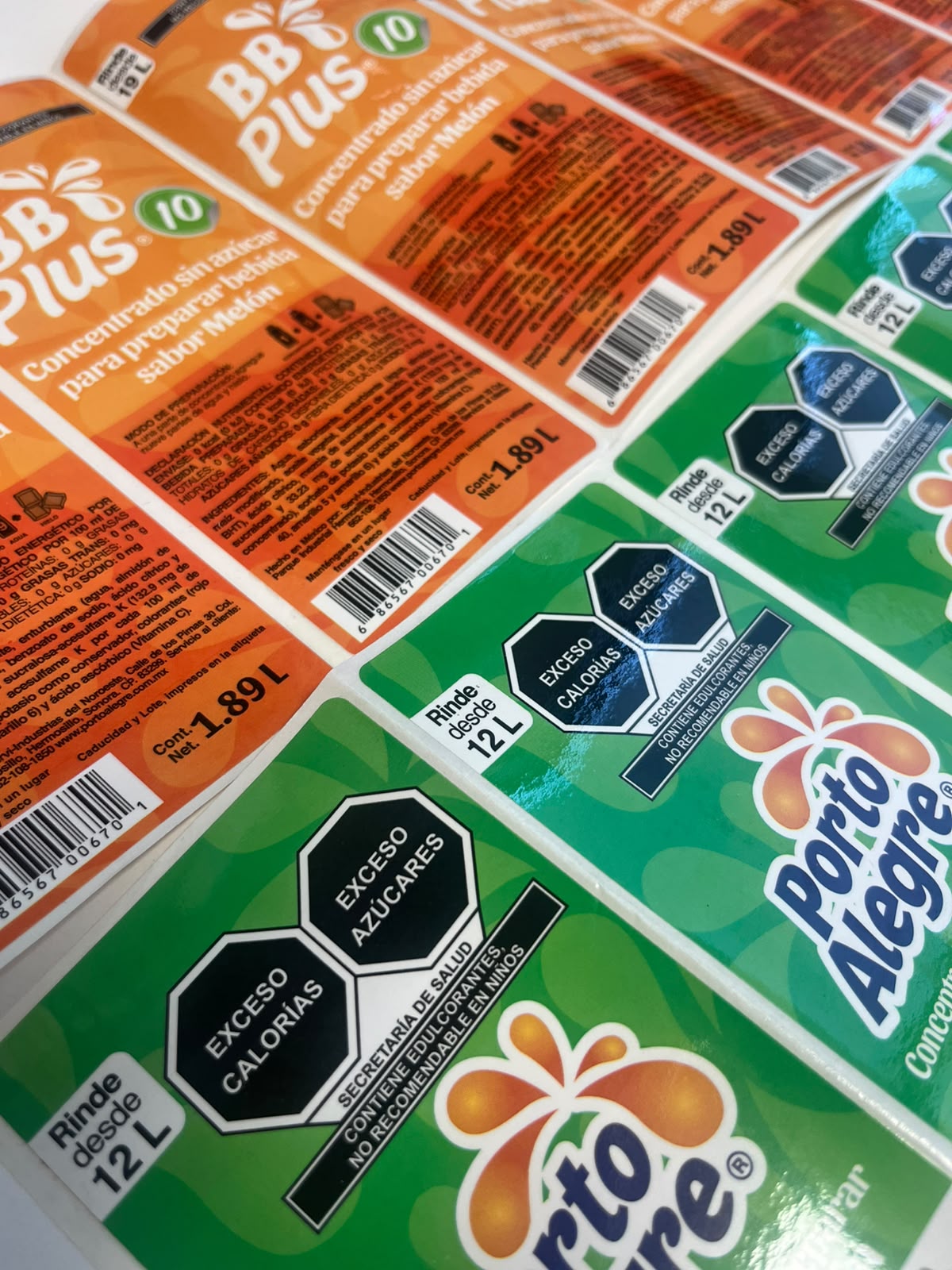

Your brand colors are one of the first things a shopper notices on the shelf. Getting them right on every label, pouch and flavor variation is not always simple. Extended color gamut printing, often called ECG, is one of the ways label printers like LPS Labels reproduce brand colors accurately and efficiently.
In this guide, we explain what extended color gamut printing is, how it works, its benefits and limits, and how to know if it is right for your next label or packaging project.
What Is Extended Color Gamut (ECG) Printing?
Extended color gamut printing is a method that uses a fixed set of seven inks to reproduce a wide range of colors. It starts with the four standard process inks, cyan, magenta, yellow and black (CMYK), and adds three more: orange, green and violet (often shortened to OGV).
With only CMYK, many bright or saturated colors cannot be printed accurately, especially strong oranges, greens, blues and purples. Adding orange, green and violet expands the range of colors the press can produce, which is what “extended gamut” means.
How Is ECG Different From Spot Color Printing?
In traditional label printing, brand colors are often printed with spot colors: inks that are mixed specifically to match one Pantone color. If a label uses three brand colors, the press needs three custom-mixed inks, and every new design may need different ones.
With ECG, the press keeps the same seven inks loaded and creates each color by combining them. Instead of mixing a new ink for every job, the color is built from the fixed ink set during pre-press.
Benefits of Extended Color Gamut Printing
– Accurate brand colors. ECG can reproduce a much larger share of Pantone colors than CMYK alone, including many bright tones that CMYK cannot reach.
– Consistency across products. When every label is printed with the same ink set, colors stay more consistent from one run to the next and across different products.
– Faster changeovers. Because the inks stay the same, there is less time spent washing the press and changing inks between jobs.
– Easier multi-SKU programs. Brands with many flavors, sizes or versions can print different designs more efficiently, since each design does not need its own set of spot inks.
– Vibrant images. Photos of food, fruit and products look richer, because the extra inks add depth to oranges, greens and purples.
When Spot Colors Are Still the Better Choice
ECG is a powerful tool, but it is not the answer for every label. Spot colors may still be the better option when:
– Your brand uses a metallic, fluorescent or specialty ink that cannot be built from process colors.
– A large area of flat, solid color must look perfectly uniform.
– The design has very small text or fine lines in a brand color, where a single solid ink prints more sharply.
– An existing label has always been printed with a specific spot ink and must match it exactly.
Many labels combine both: ECG for images and most colors, plus a spot or metallic ink where it adds the most value. Our team helps you decide which approach fits your design.
Is ECG Right for Your Labels?
Extended color gamut printing is a great fit if:
– You have several products or flavors that share the same brand colors.
– Your labels include colorful photography, such as food, produce or beverages.
– You want consistent color between reorders and across your product line.
– You are launching new designs often and want to keep production simple.
How LPS Labels Uses Extended Color Gamut Printing
At LPS Labels, we print custom labels and flexible packaging on flexographic presses in our Phoenix, Arizona plant. Our pre-press team reviews your artwork, identifies your brand colors and decides how each one will be reproduced: with the extended color gamut, with a spot ink, or with a combination of both.
Before production, we send you a proof so you can review your colors and approve the design. That way, you know what to expect before your labels go to press.
Frequently Asked Questions
What does ECG stand for in printing?
ECG stands for extended color gamut. It means printing with CMYK plus orange, green and violet to reproduce a wider range of colors than four-color process alone.
Can ECG match my Pantone colors?
ECG can match a large share of Pantone colors closely. Some colors, like metallics and fluorescents, still require a dedicated spot ink. We review your brand colors and let you know which ones can be reproduced with ECG.
Is extended color gamut printing more expensive?
Not necessarily. Because the press does not need custom-mixed inks or as many ink changes, ECG can be cost-effective, especially for brands with several designs. The final cost depends on your label size, quantity and finishes.
Do I need to prepare my artwork differently for ECG?
No. You can send your artwork as usual, preferably as a vector PDF with your brand colors specified. Our pre-press team prepares the files for extended gamut printing.
Get Accurate Color on Your Next Label
If color consistency matters for your brand, extended color gamut printing may be the right solution. Contact LPS Labels to talk about your project, request free samples, or get a quote for your custom labels and packaging.